
7 Insights from the 20th Century’s Most Prescient Dystopian Tale
The 1909 story that eerily predicted our tech-mediated lives

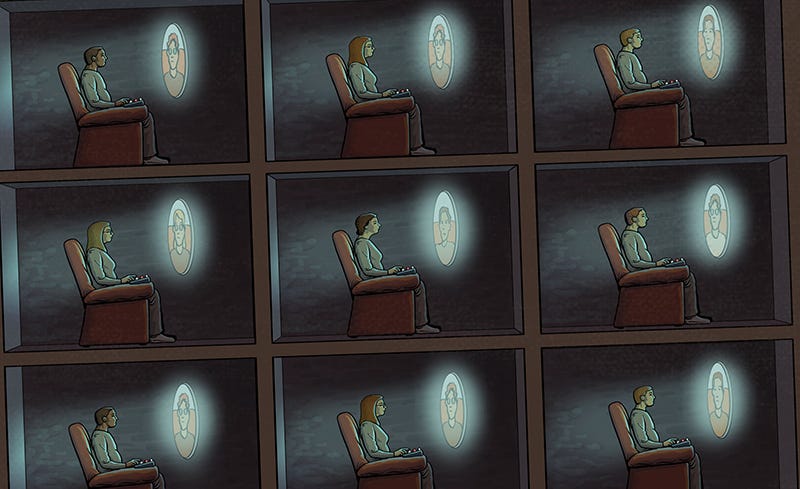
Tales of dystopian futures offer an incomparable way to consider where our own society might end up. 1984 continues to sharpen our lens on the subtle creep of surveillance and the manipulation of truth. Brave New World has helped us see how comfort, pleasure, and distraction can pacify a population more effectively than force.
But for my money, there’s no narrative more prescient — and insight-generating — than a short story (really more of a novella) penned by E.M. Forster in 1909: “The Machine Stops.”
“The Machine Stops” paints a picture of a future society that, because the earth’s surface has become uninhabitable, lives in a honeycomb of “cells” beneath it. Technological advancements, controlled and mediated by an all-encompassing system called “the Machine,” allow individuals to summon food, medicine, entertainment, and worldwide communication channels at the flip of a switch. The citizens of this push-button civilization rarely have reason to leave their chairs — or their rooms.
A decade before radios became mainstream, “The Machine Stops” predicted the rise of on-demand music and broadcasts.
Fifty years before air travel became common, it foresaw a time when it would be easy to hopscotch the globe.
A century before Skype debuted, it envisioned the idea of video calls.
But it’s not its prescience around technological developments that makes “The Machine Stops” so striking. It’s the story’s discernment of what those developments would do to people that’s both disturbing, and illuminating.
What Forster imagined, we’ve begun to live out.
Today, I’ll dig into seven insights from his fiction that allow us to see our own reality afresh.
