
Ex Libris: Man's Search for Meaning

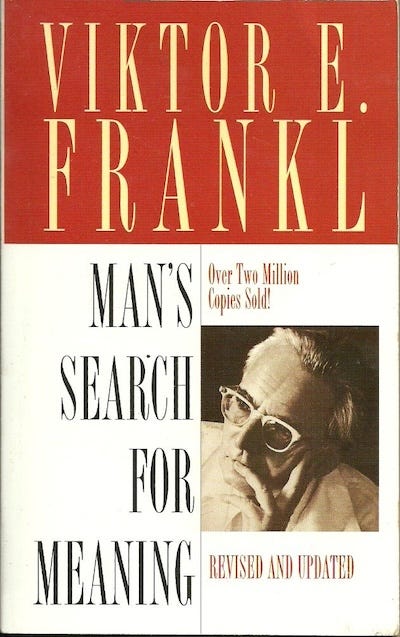
I’m starting a periodic series on Dying Breed called Ex Libris (Latin for “from the library of”).
In this series, I’m going to highlight books from my library that mean a lot to me. These are the ones I’ve re-read multiple times, continue to influence my life, and have shaped how I think about the world. Each entry focuses on a single book: my personal history with it and three specific takeaways that have stuck with me over the years. Maybe it will inspire you to pick one up and give it a read — or a re-read.
There was really only one choice for the inaugural Ex Libris entry: Man’s Search for Meaning by Viktor Frankl.
The Synopsis
If you’ve somehow managed to miss this book (and if you have, you really need to rectify that), it’s essentially two books in one.
The first half is a memoir. It chronicles Frankl’s three years spent in four different Nazi concentration camps, including Auschwitz and Dachau. It’s grim, of course. But it’s not just a catalog of horrors. Frankl writes as a psychiatrist observing himself and his fellow prisoners, analyzing how the human mind reacts when stripped of every comfort, dignity, and possession.
In the second half, Frankl introduces “Logotherapy,” his school of psychotherapy. Unlike Freud, who thought we were driven by a “pleasure principle,” or Adler, who thought we were driven by a “will to power,” Frankl argues that our primary drive is a “will to meaning.” We are creatures who fundamentally need to find meaning in our lives, even in our suffering. And we find that meaning by making choices.
How the Book Came Into My Life
I first encountered Frankl’s work when I was sixteen.
For some reason, I decided to read Stephen Covey’s The 7 Habits of Highly Effective People (another book that has had a big impact on me and will likely be highlighted in a future Ex Libris installment). I don’t know why I had a hankering to read that book. I was involved with student council and interested in leadership, but it might have just been because my dad was taking a Franklin Covey course at work at the time.
As I was reading Covey’s classic, I noticed that in a section about being proactive, he mentioned a psychiatrist who had survived the Nazi concentration camps by realizing that while his captors could control his environment, they couldn’t control his internal response to it. That psychiatrist was, of course, Viktor Frankl.
Intrigued, I picked up a paperback copy of Man’s Search for Meaning and devoured the entire book in a single day. Then I read it again.
I highlighted the absolute crap out of that book. The margins were a mess of ink and scribbles. I journaled about it.
Since then, this slim volume has been a constant companion. I’ve re-read it more times than I can count. I’ve gifted it dozens of times. Kate has read it. My son Gus has read it. Scout, my daughter, will read it this year.
The thing that keeps bringing me back to Man’s Search for Meaning is the foundational idea that undergirds Frankl’s philosophy: we are creatures with a drive for meaning, and we find meaning by exercising our agency, especially in those moments when making the noble choice is the hardest.
3 Key Takeaways
Here are three lessons from the book that I return to again and again:
