

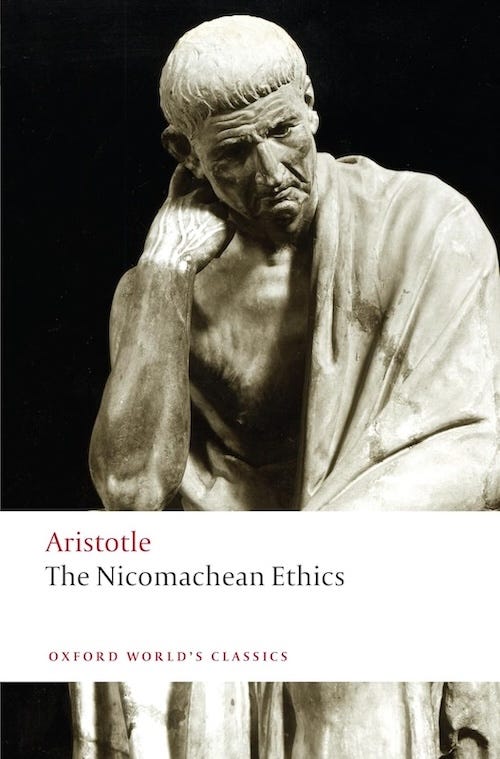
Welcome back to Ex Libris, a series where I highlight books from my library that mean a lot to me. These are the ones I’ve re-read multiple times, continue to influence my life, and have shaped how I think about the world. Each entry focuses on a single book: my personal history with it and three specific takeaways that have stuck with me over the years. Maybe it will inspire you to pick one up and give it a read — or a re-read.
Today’s edition, Aristotle’s Nicomachean Ethics.
The Synopsis
The Nicomachean Ethics is Aristotle’s attempt to answer a perennial question: what does it mean to live a good life?
Written around 350 BC and compiled from his lecture notes (his son Nicomachus likely edited them into their current form — hence the name), the book is Aristotle’s systematic account of what he calls eudaimonia. The word gets translated as “happiness” or “flourishing,” but neither quite captures it; there isn’t an English word with direct correspondence.
Eudaimonia isn’t a feeling. It’s not the warm fuzzies you get from a good meal with friends or achieving a long-term goal. You can definitely experience those feelings in a eudaimonic state, but they’re not eudaimonia. Rather, eudaimonia is an activity. Aristotle defines it as “the activity of the soul in accordance with virtue” over a complete life. To flourish is to live and act well, not merely to feel good.
The book ranges across everything from the nature of courage and generosity to the role of friendship, the mechanics of moral development, and why you can’t really judge whether a man’s life went well until it’s over. It’s sprawling and occasionally dense. It also happens to be the most useful book about how to be a human being I’ve ever encountered.
How the Book Came Into My Life
I first read the Nicomachean Ethics in high school. It might have been my senior year. Around that time, I discovered Mortimer Adler’s book How to Think About the Great Ideas at the public library in Edmond, OK. Adler is famous for popularizing the Great Books, and he was big on Aristotle. Real big. So Aristotle got a lot of mentions in that book. Intrigued, I picked up a copy of the Nicomachean Ethics and started reading it. I marked that bad boy up and have been hooked ever since.
I’ve lost count of how many times I’ve re-read the Nicomachean Ethics since then. I read it a few times in college philosophy classes and in book groups I’ve belonged to. I’ve also re-read it on my own several times just for fun. The book keeps pulling me back, and I’m always rewarded with a new insight about living life well.
While Stoicism gets all the attention in the modern day, and Aristotle, who didn’t write in pithy maxims, doesn’t get as much play, I’ve always felt like Aristotelianism is a more complete philosophy — one that best understands, and works within, the human condition.
If you’re a longtime reader of AoM, you’ve likely noticed that Aristotle shows up regularly in our articles and podcast episodes.
If you’re a member of The Strenuous Life, you know that developing your phronesis — or practical wisdom — is baked into the program as a core principle. That idea was cribbed directly from the Nicomachean Ethics.
I bring Aristotle up with my kids at the dinner table. They roll their eyes at me when I do, but I hope some of it is sticking. I brought Aristotle up with the boys I coached in flag football. I bring him up with the teenagers I lead at church. There really is no bad time, as far as I’m concerned, to pull out Aristotle and his Ethics on the question of how to live life well.
