
What's Your Stance?

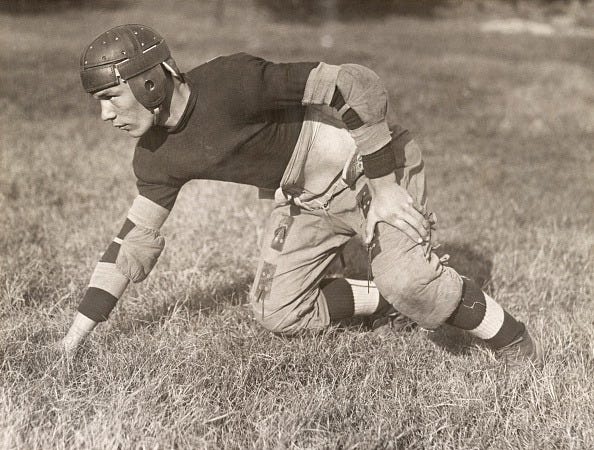
When you’re learning to play American football, one of the first things you’re taught is how to set your stance.
Whether you’re a lineman, linebacker, or cornerback, it’s important to adopt what coaches call an “athletic stance”: feet a little wider than shoulder-width apart, right foot slightly staggered behind your left, knees bent, and your weight distributed on the balls of your feet. From there, if you’re an offensive lineman, you can place a hand on the ground to assume the traditional three-point stance. But before you get there, you need a good athletic stance.
Athletic stances aren’t just limited to football. Baseball infielders assume an athletic stance before a pitch. Wrestlers take an athletic stance. Basketball players on defense take an athletic stance.
What does the athletic stance do? Well, a lot.
Placing your feet shoulder-width apart gives you lateral stability. You’re able to move in any direction without crossing them. The staggered right foot lets you take a quick first step while still maintaining your stable base. Your slightly bent knees make your body like a spring coiled for action. It creates potential energy that can be converted to kinetic energy. Keeping your weight slightly on the balls of your feet allows quick, unhesitant movement in any direction.
An athletic stance also works on your mind. It puts you in a flexible mental state. An athletic stance nudges you to take in the entire field of play so that you can orient yourself to what might be coming your way, but it also allows you to quickly shift your focus to just a single player or the ball. An athletic stance allows a player to quickly shift between a wide and a narrow focus.
There’s also a mood or an attitude to an athletic stance. When you adopt that position, you feel more alert and engaged. You feel proactive rather than passive. The athletic stance makes you feel agentic.
I think about the athletic stance a lot because I see the idea of a “stance” as powerful and applicable across all domains of life.
A Stance Is a Way You Orient Yourself to Your World
When most people use “stance” outside of sports, they usually mean a set of beliefs about a political or moral issue.
What’s your stance on immigration? On smartphones in schools? On the death penalty? On abortion?
But when philosophers in the existentialist and pragmatist traditions talk about a stance, they mean something a bit different. It’s more like an athletic stance.
The philosopher of science Bas van Fraassen offers a helpful way to explain what a stance is. In a series of lectures on empiricism (later published as The Empirical Stance), he made a distinction between doctrines and stances. A doctrine is a set of propositions you believe to be true or false. A doctrine can be falsified, confirmed, and argued with. A doctrine is basically the typical way we use the word “stance.” “My stance on immigration is ____.”
But van Fraassen doesn’t think that’s what a stance is. For him, a stance is a cluster of attitudes, values, and commitments that orient you in a certain way. It’s a way of engaging with the world. For him, an “empirical stance” is a way of understanding the world through experience and science. An empirical stance leaves you open to changing your mind based on new data. When you take an empirical stance, you question and observe instead of making final judgments and conclusions.
Other philosophers define a stance similarly: a stance is a way you orient yourself to your world.
This idea of a stance is much the same as an “attitude.” The etymology of the word “attitude” basically means stance. It started off as the Italian word attitudine. In the 1660s, attitudine was used to describe the pose or posture of a figure in a painting or sculpture, in other words, its stance. Over the centuries, the word attitude morphed into what it means for us today: a way of thinking and feeling.
Philosophers will often use the words stance and attitude interchangeably. But I like the word stance better. Why? It viscerally captures something fuller about how we orient ourselves in the world. It feels more action-oriented and embodied, and I like that.
The Elements of a Stance
So a stance is a way you orient yourself to your world.
But what makes up a stance?
